A Kurawa
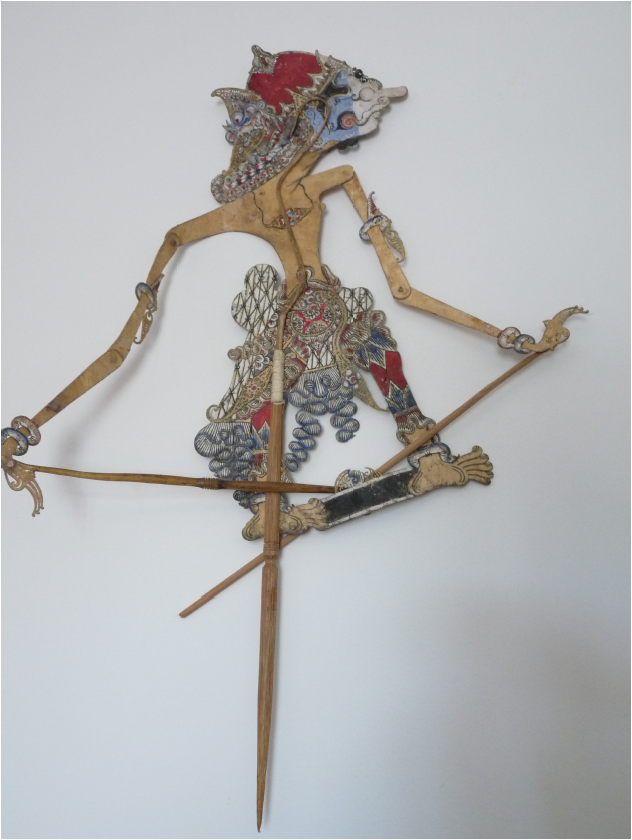
A Kurawa, probably Dursasana or Citraksa, Solo style. While we can identify this puppet by his headdress as one of the hundred Kurawa brothers who are the villains of the Mahabharata, it is often difficult to distinguish between them, partly because in the story they are all divisions of the same whole.
According to the Mahabharata, when his mother Gandhari's pregnancy continued for an unusually long period of time, she beat her womb in frustration and envy of Kunti, the queen of Pandu, who had already given birth to three of the five Pandawas. Due to her actions, a hardened mass of greycolored flesh emerged from her womb. Gandhari, devastated, called upon the great sage Vyasa, who had blessed her with one hundred sons, to redeem his promise.
Vyasa divided the flesh ball into one hundred equal pieces and put them in pots of ghee, which were sealed and buried in the earth for one year. At the end of the year, the first pot was opened, and Duryodhana (the king of the Kurawas) emerged. The next Kurawa brother to be born was Dursasana. Dursasana is devoted to his older brother Duryodhana, and is also closely involved in the various schemes and plots to kill the Pandawas. Citraksa and his identical twin Citraksi are among the younger Kurawas, and are often the targets of the second-generation Pandawas like Gatotkaca. From the bulbous features and blue face of this figure, we can see that he is coarse of character and quick to anger, but cowardly. These characteristics are often emphasized in performance by a harsh and stuttering vocal style.
Image: 45cm (73cm with handle) x ~24cm; water buffalo hide, wood.
Nelson South East Asia Collection © 2025