Hanuman
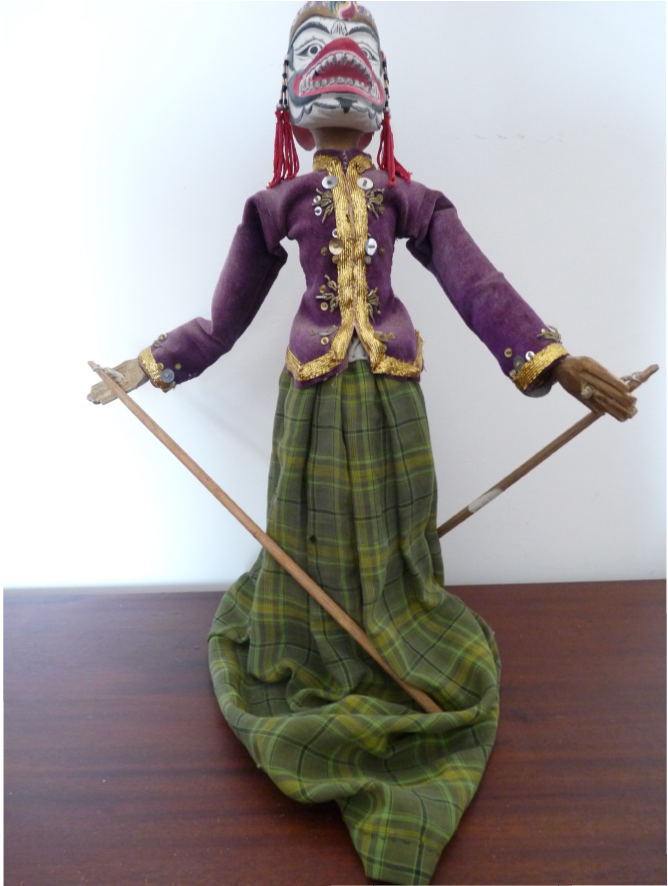
In Hindu mythology, Hanuman is the monkey commander of a great monkey army, and as such plays a central role in the Ramayana (“Rama’s Journey”).
While still a baby, Hanuman, a child the wind god, tried to fly up and grab the Sun, which he mistook for a fruit. Indra, the king of the
gods, struck Hanuman with a thunderbolt on the jaw (hanu), thus inspiring the name. When Hanuman continued to misbehave,
powerful sages cursed him to forget his magic powers, such as the ability to fly or to become infinitely large, until he was reminded of them. In The ramayana, Hanuman is redeemed by leading his monkeys to help Rama, (an avatar of the god Vishnu) recover his wife, Sita, from the demon Ravana, king of Lanka. Having been reminded of his powers by Jambavan, the king of the bears, Hanuman crossed the strait between India and Lanka in one leap. He was discovered in Lanka, and his tail was set on fire, but he used that fire to burn down
Lanka. Hanuman also flew to the Himalayas and returned with a mountain full of medicinal herbs to restore the wounded in Rama’s army.
In Bali, Hanuman is worshipped as a subsidiary figure in temples dedicated to Rama or directly in shrines dedicated to Hanuman himself. The latter are generally thronged by monkeys, who know that they cannot be mistreated there. For his service to Rama, Hanuman is upheld as a model for all human devotion. In wayang performances, however, it is the combination of his heroic and michievous qualities that make him a favourite character.
47cm (with stand) x 13cm; puppet-- wood, fabric (cotton and velvet), glass and metal beading, wool tassels / stand-- plastic bottle, sand.
Nelson South East Asia Collection © 2025