Salya
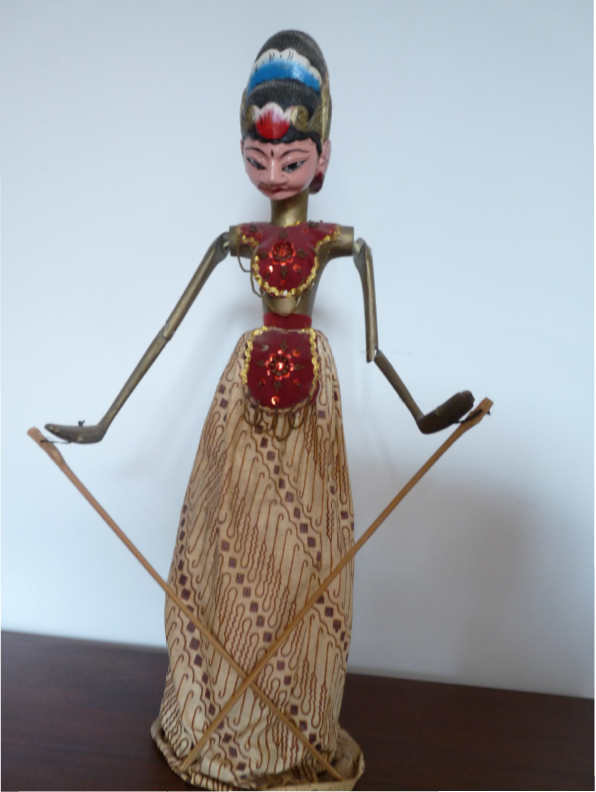
As in wayang kulit, the styling of wayang golek puppets tells us much about the character of the figure depicted. Here we have a royal male character of refinement, as shown by the lack of arm decorations, the narrow eyes, and the generally aquiline features; his upright head and forward glance, however, indicate that he is energetic anf forthright, while his pink face tells us that he is sometimes prey to a quick temper or other passions. These details, along with the shape of his headdress, suggest that this is probably Salya, king of Mandraka and an important intermediary character in the Mahabharata. Though Salya is tricked into allying himself with the Kurawas, he sympathizes with and has familial ties to the Pandawa brothers.
In the Mahabharata, King Salya is the brother of Madri (mother of the younger Pandawas Nakula and Sahadewa), as well as the ruler of his own kingdom. A powerful yet righteous prince, Salya has a unique gift he becomes stronger when faced with aggression, hence requiring everyone to be kind towards him. In Sanskrit, Salya means thorn or dart, and, being a skilled archer, a powerful mace
fighter and a formidable warrior, Salya is tricked by Duryodana to fight the war on the side of the Kurawas. Salya is an incredibly calm and deliberate fighter, and is practically invincible until Krishna suggests that Yudistira should kill the powerful warrior because the eldest Pandawa is a man of peace and can meet Salya in battle without triggering his magical protection against aggression.
As an unusually complex character by the standards of wayang, Salya is often used as a commentary figure on Indonesian politics. His divided loyalties and allegiance to both the Pandawas and his official allies the Kurawas, along with his growing respect for the Kurawa hero Karna, are used by many dalangs as allegory for the very personal and often chaotic relationships among contemporary politicians.
59cm (with stand) x 13 cm; puppet-- wood, fabric (cotton and velvet), glass and metal beading, ribbon / stand-- plastic bottle, sand.
Nelson South East Asia Collection © 2025